Research Program
Unified investigation of how the past shapes cognition and behavior through spatio-temporal dynamics
Core Academic Mission
Build a unified computational account of spatio-temporal interaction — how the brain jointly infers time, space, and quantity from a continuous stream of experience, and how attention and past responses shape that inference.
Dimensional Extension
Pure time → Time × Space × Quantity (generalized magnitude)
Method Upgrade
Likelihood/prior/loss → Representation learning & Latent dynamics
Empirical Testbeds
fMRI time×direction, time×quantity behavior, cross-species data
Unified Research Spine
Serial dependence as a generative latent process: precision-weighted integration → feedback-gated retention → control-dependent readout → metacognitive monitoring
Integration
Precision-weighted updating of sensory information
Retention
Trial-to-trial dependence maintained by feedback
Readout
Task-dependent control of response generation
Monitoring
Metacognitive assessment of uncertainty
Research Directions
Sequential Cognition & Serial Dependence
How past responses shape current perception and decision-making. Serial dependence in behavior, confidence, and metacognition across different contexts and uncertainty levels. Understanding feedback-gated retention and trial-to-trial dynamics.
Spatio-temporal Cognition
Joint inference across time and space dimensions. How the brain integrates temporal and spatial information, generalizes across dimensional interactions (time×space×quantity), and adapts to dynamic environments. Includes attention-weighted timing — how self-paced exploration and uncounted gaps compress subjective duration.
Computational Methods & Neural Tools
Advanced computational approaches: Bayesian inference, Kalman filtering, latent dynamics modeling, and deep learning. Implementation in brain-computer interfaces, VR systems, and multi-modal neural data analysis.
Research Methods & Applications
Cross-species Neural Dynamics
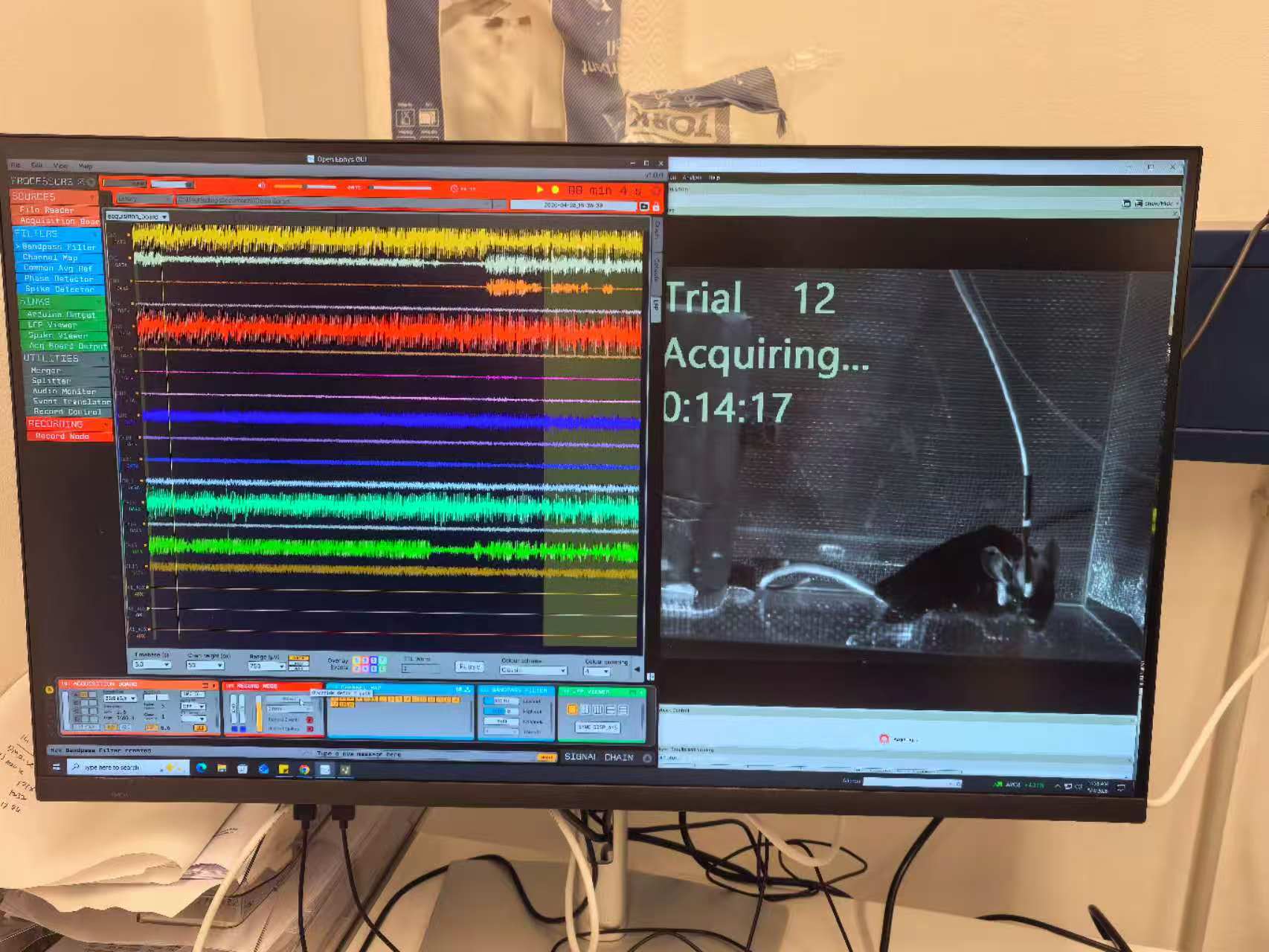
Mouse calcium imaging to understand serial dependence mechanisms at the neural level. Motion correction, ROI segmentation, and neuronal activity visualization reveal how neurons encode trial-to-trial dependencies and sequential effects across species.
Status: Submitted to Neuron | Partner: Max Planck Institute for Biological Intelligence
Brain-Computer Interface
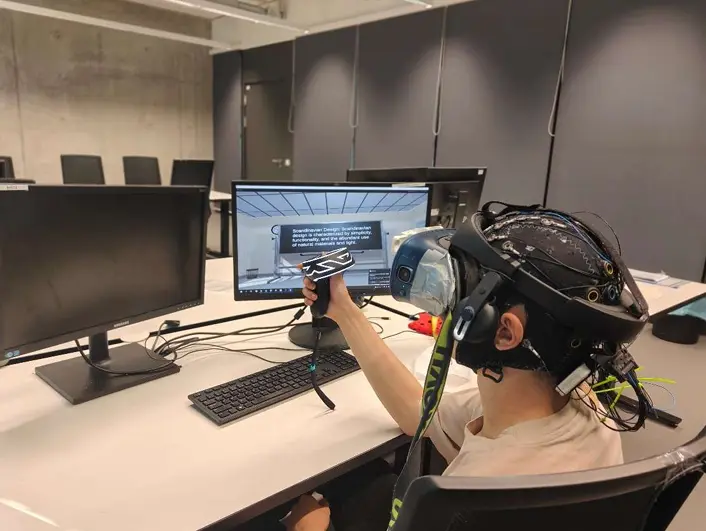
Hybrid BCI systems combining multiple neural recording modalities (fNIRS, EEG) for real-time neural decoding and sensorimotor applications in immersive virtual environments. Directly implements precision-weighted inference and feedback mechanisms.
Internship: Technical University of Munich (MIBE) | Duration: 05/2024 - 11/2024
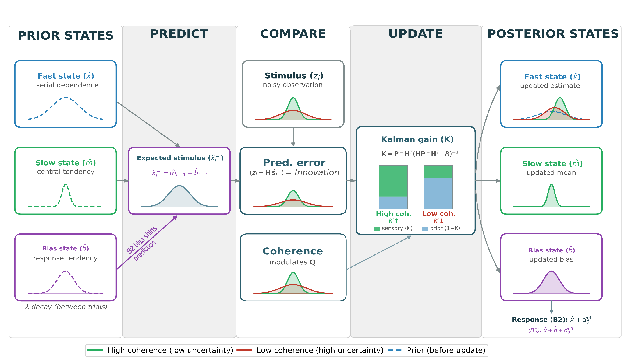
Computational Foundation: 3-State Kalman Filter
The 3-state Kalman filter serves as the theoretical anchor for understanding precision-weighted inference in serial dependence. This framework models:
- 1.Clock state: Internal timing signal
- 2.Memory state: Integration of past information
- 3.Decision state: Response generation
This model explains how precision-weighted updating and feedback-gated retention produce trial-to-trial dependencies across sensory and contextual transitions.
Key Data Assets
fMRI Time-Direction
N=28
fMRIPrep complete
Behavioral SD Suite
6+ datasets
Multi-experiment
Mouse Calcium Imaging
Cross-species
Submitted to Neuron
Eye-tracking + EEG
N=23
Preprint (bioRxiv)
fMRI Decision Confidence
Multi-run
GLM analysis complete
Computational Models
135-model space
3-state Kalman